

CASE STUDY
Smart Manufacturing | AGV and Automated Storage Concept
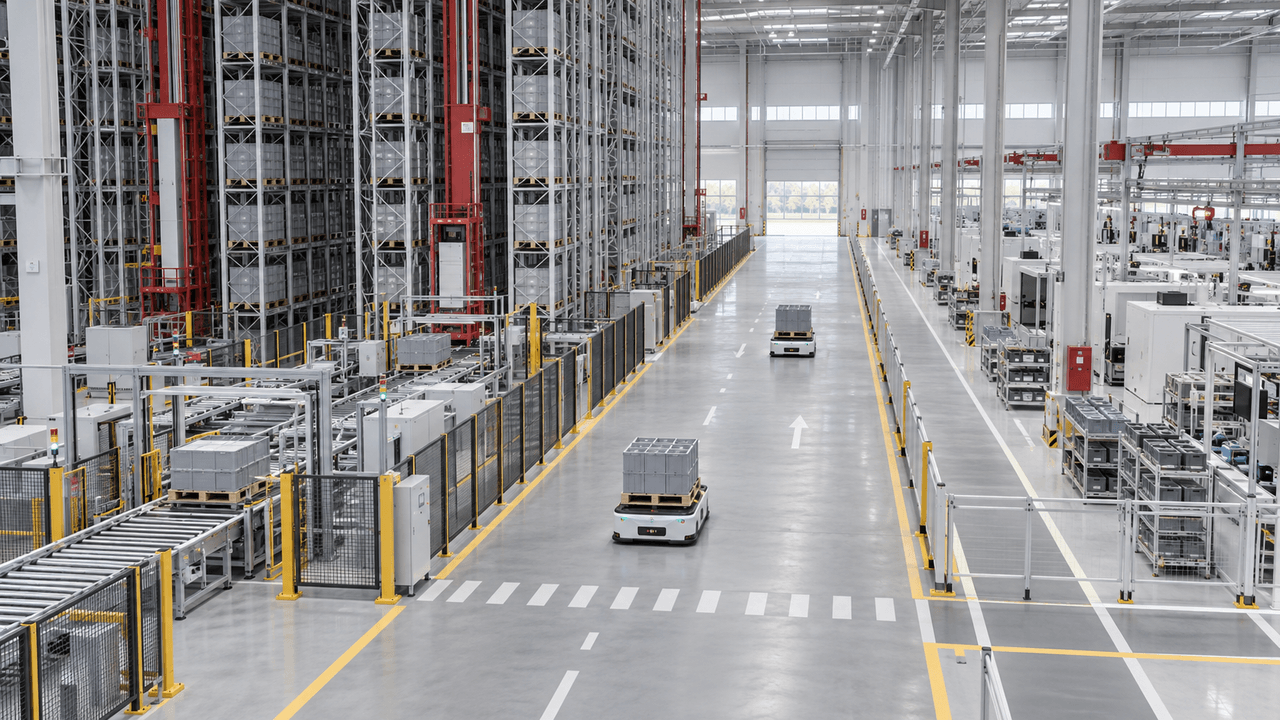
Illustrative proposal connecting orders, material handling, AGVs, automated storage and line-side replenishment. Images are AI-generated concepts.
On this page
Illustrative proposal: This concept explains a planning method for a typical manufacturing setting. It does not describe a real client or completed engagement. Images are AI-generated; detailed engineering and safety design require project-specific work.
Scenario and objectives
Assume a discrete manufacturer with distributed material storage and manually requested transfers. The organization wants to assess automated storage and AGVs for material flow and traceability.
Collect product families, order variability, load-carrier specifications, movement frequency and site constraints. Vehicle counts, storage positions and payback are deliberately not invented; they require validated data.
Design from tasks to space
Define receiving, inspection, put-away, picking, replenishment, production returns and empty-carrier recovery as distinct tasks. Assign triggers, physical status and completion confirmation.
Segment storage by form, access frequency, batch rules and rotation requirements. Decide which loads suit automation and which need other arrangements.
Identify transfer points, waiting areas, service access and manual recovery. Equipment and safety specialists must evaluate crossings and operating parameters.
Establish information responsibilities
Agree the boundaries between order and production systems, warehouse management and equipment dispatch. Align identifiers for materials, batches, carriers and tasks. Assign authority for manual confirmation and exception recovery.
Validate in stages
Compare layouts and test peaks, queues and partial unavailability through appropriate simulation or trials. Start with limited tasks and a product family before expanding.
Deliver layouts, task and data definitions, interface ownership, exception scenarios and acceptance criteria. Evaluate response, stock accuracy, recovery, maintenance and total investment using actual operating evidence.